The Politically Incorrect Guide to the British Empire by H. W. Crocker III
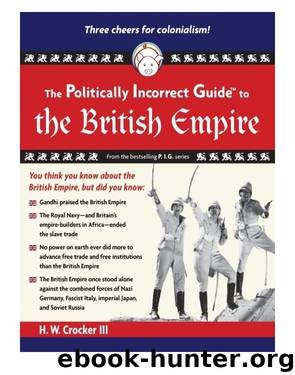
Author:H. W. Crocker, III
Language: eng
Format: epub
Publisher: Regnery Publishing
Published: 2011-10-11T04:00:00+00:00
Sir Frederick (later Lord) Lugard, governor of Nigeria (and earlier of Hong Kong), quoted in James Morris, Farewell the Trumpets: An Imperial Retreat (The Folio Society, 1992), p. 323
The key phrase was “we can show the Negro what we are.” Lugard was the man who shaped the British civil service in West Africa, and he shaped it in his own upright, paternalistic image. A District Commissioner had to be courageous and strong, a man with moral force and a Maxim gun to back it up: “we do not intend to be fooled . . . we come like men that are not afraid,”5 as he said when he marched into Uganda. The District Commissioner had to be a fair and disinterested dispenser of justice, and he had to advance the cause of civilized standards and economic development and enterprise.
Lugard’s method was indirect rule—ruling through local elites who had been won over to the imperial cause—which was a common enough British imperial strategy but one that he developed, expounded, and made his own as a practical political philosophy. It meant that the hundred disparate tribes of Nigeria could be governed in ways that preserved their traditions and cultures, while a British representative was kept on hand to make sure that all due obeisance was given to fair play, free trade, and the requisite moral decencies (though these sometimes required a sliding scale, as even the anti-slavery-minded Lugard tolerated, up to a point, the limited practice of slavery in Islamic northern Nigeria).
Lugard envisioned African self-government at a local level, leading eventually to self-government at a regional level, and after some considerable time at the highest level in independent states. Africa was his passion, but unlike later liberals he did not clothe the Africans with any sort of inherent moral superiority; on the contrary, his view, based on his long, adventurous experience on the continent, was a justification for imperial paternalism. The average African, he said, tended to be a “happy, thriftless, excitable person, naturally courteous and polite, full of personal vanity, with little sense of veracity . . . his thoughts are concentrated on the events and feelings of the moment, and he suffers little from apprehension of the future or grief for the past.”6 It was the Empire’s role to guide such men in the ways of honesty, industry, and sobriety.
The Missionary with Only One Convert
Among the soldiers and explorers and Randlords of Britain’s African empire, perhaps the most famous imperialist of all was a Protestant medical missionary, Dr. David Livingstone (1813–73). As a missionary in Central Africa, Livingstone cured the sick; tried (and failed) to interest the natives in a non-polygamous religion (he made only one partial convert); and became an ardent African explorer—believing this was his true calling, and one not unrelated to preaching the gospel. As a Scotsman, he had also absorbed the teachings of Adam Smith and believed in the holy trinity of Christianity, commerce, and civilization: commerce required navigable rivers, increased trade with Britain might displace
Download
This site does not store any files on its server. We only index and link to content provided by other sites. Please contact the content providers to delete copyright contents if any and email us, we'll remove relevant links or contents immediately.
| Anthropology | Archaeology |
| Philosophy | Politics & Government |
| Social Sciences | Sociology |
| Women's Studies |
The Secret History by Donna Tartt(19088)
The Social Justice Warrior Handbook by Lisa De Pasquale(12190)
Thirteen Reasons Why by Jay Asher(8910)
This Is How You Lose Her by Junot Diaz(6887)
Weapons of Math Destruction by Cathy O'Neil(6280)
Zero to One by Peter Thiel(5802)
Beartown by Fredrik Backman(5754)
The Myth of the Strong Leader by Archie Brown(5507)
The Fire Next Time by James Baldwin(5446)
How Democracies Die by Steven Levitsky & Daniel Ziblatt(5219)
Promise Me, Dad by Joe Biden(5153)
Stone's Rules by Roger Stone(5088)
A Higher Loyalty: Truth, Lies, and Leadership by James Comey(4964)
100 Deadly Skills by Clint Emerson(4925)
Rise and Kill First by Ronen Bergman(4789)
Secrecy World by Jake Bernstein(4753)
The David Icke Guide to the Global Conspiracy (and how to end it) by David Icke(4720)
The Farm by Tom Rob Smith(4513)
The Doomsday Machine by Daniel Ellsberg(4490)
